A strong snowboard stance is the foundation of good technique. When most people begin snowboarding, they use the stance that their local shop set up for them when they were buying or hiring.
There are thousands of permutations for your bindings and the stance is the foundation of all technique, whether it’s for riding piste, park or powder, so it’s very important to get it set up just right for you. It only takes about 15 minutes to set up a strong stance, but the benefits in both the ability to balance and have strong directional control of your snowboard are greatly increased.
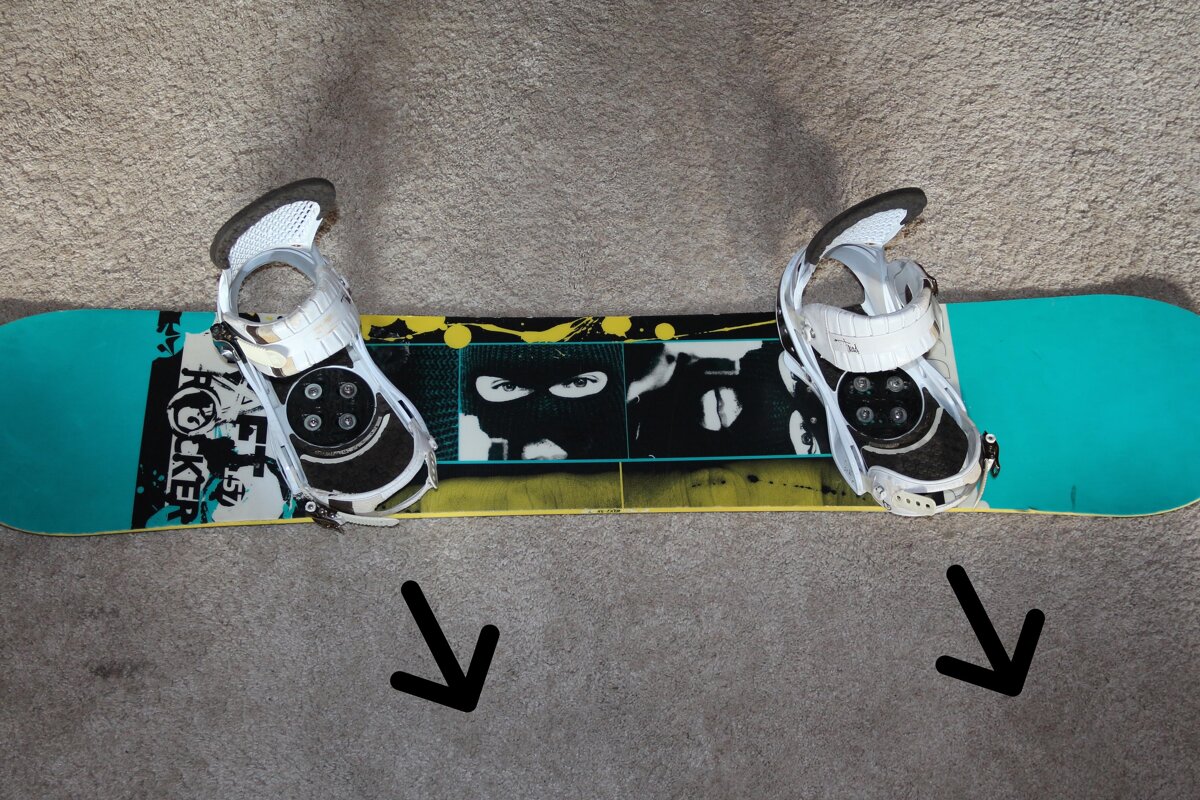
To begin with you will probably keep your stance quite neutral with both feet evenly set up on the board, but as you start to turn your board and learn to control it your feet will move outwards so your toes are pointing towards the tip and tail.
Ideally for everyday riding you will want to adopt a "duck foot" stance, although it's probable that your front foot will have more angle on it than your back. Ultimately it's all about personal comfort, but whatever you decide you shouldn't have more than 30 degrees of difference between your two feet.
How to set up your stance:
- stand upright in a relaxed posture with feet around shoulder width apart and feel how hard you can push against the ground one foot at a time, firstly with the toes then with the heel
- now make the distance between the feet around 1-2cm wider and repeat the process of pushing through the four areas (toes then heel on left foot, then the same on right foot)
- repeat this step again and you should be feeling that as the distance between your feet increases, the amount of pressure you are able to push through your toes and heels also increases (this pressure is fundamental in developing board control)
- keep repeating and at a certain point the distance between your feet will start to become too much, and will result in the feeling of your inner thigh / groin area being a little over stretched. When this occurs reduce the distance between the feet a little until it is a comfortable stance where no stretching or discomfort is felt but the ability to push through the feet is at its strongest
- now keeping the distance between the feet, gently move the knees out so they are directly over the feet and then, looking at the direction that the thigh bone is pointing in, rotate each foot to match that direction (from the top of the thigh bone to the toes of each foot should all be aligned). Now you should be able to bend and flex without any tension in the legs, ankles or knees (bending and flexing are important movements in snowboarding to help balance)
- lastly to ensure a good field of vision, increase the angle of the front foot by just a few degrees and decrease the angle of the back foot by the same few degrees. This should now orientate the stance with just a few degrees biased toward the front foot and reduce the need for upper body rotation to see where you're going, whilst at the same time maintaining the angle difference between the feet to keep a strong stance
With this new strong stance you should feel a bigger platform between your feet, which will greatly increase your ability to maintain a balanced posture and at the same time give you the ability to generate strong pressures through the board to maximise your control.
It's very important to try to maintain a relaxed posture with the upper body and shoulders in line with your snowboard, even the slightest upper body rotation will result in a rotation of the hips which pulls the back knee inside the rear foot. With the knee in this position it now creates a block in the stance in which bending for balance is now very difficult.
With a strong stance set up and a good upper body posture (in line with the snowboard), you can now focus on developing good snowboard control technique using pressure through the outsides of the feet to turn the board.